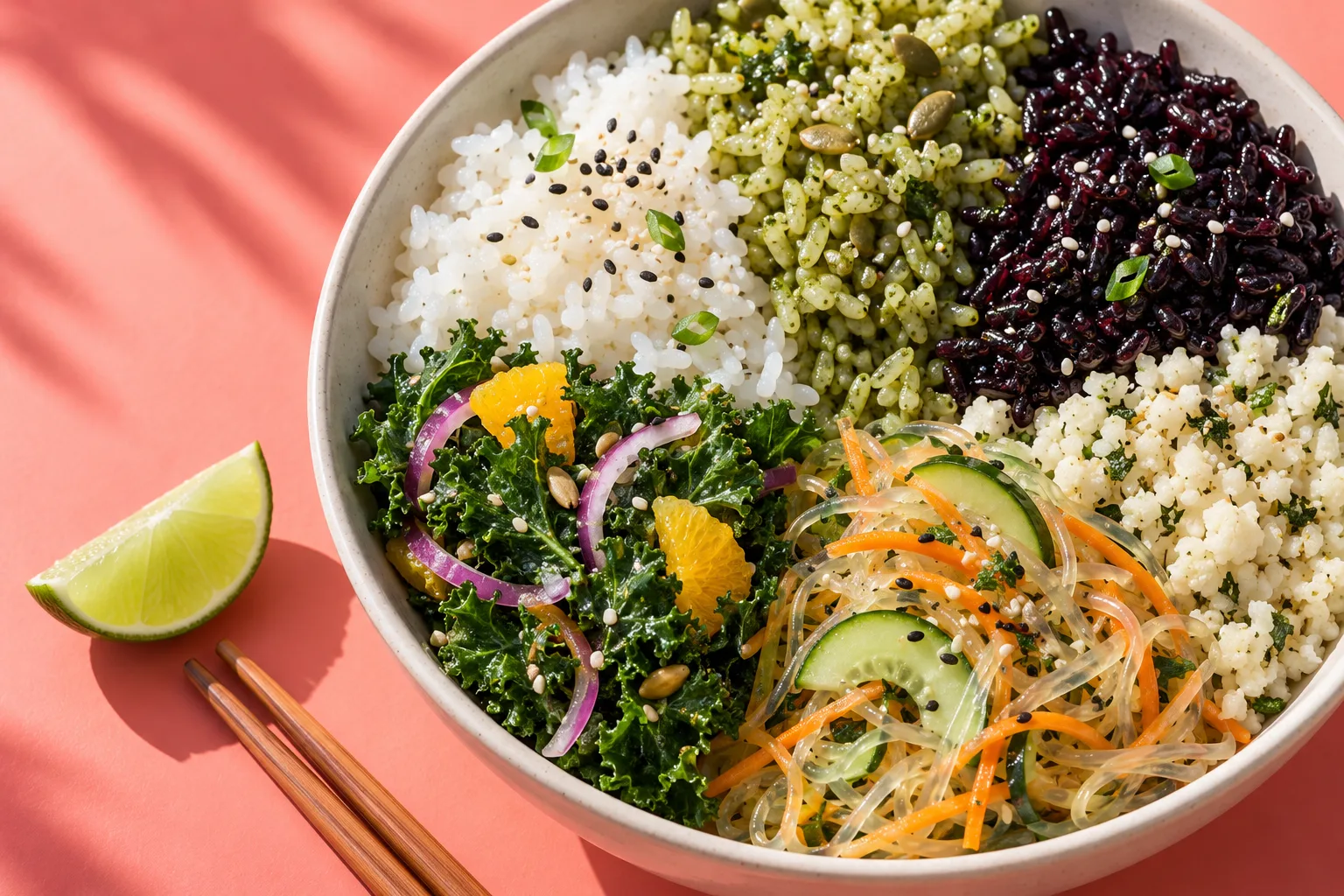
Every poke bowl starts with a base, and that choice shapes how the bowl tastes,how it feels to eat and how heavy or light it sits. At Sweetfin, the base is the firstdecision you make when you build your own bowl, and there are six to choosefrom: sushi rice, bamboo rice, forbidden rice, cauliflower rice, citrus kale saladand kelp noodle slaw. Three are rice and three are vegetable- or seaweed based, so you can build anything from a classic poke bowl to a grain-free one.
Here we look at all six bases from our ingredient guide. You’ll find out what each one is, how theydiffer and what they pair with, whether you start from a signature bowl or build your own. Everybase is part of a menu that’s 100% gluten-free.
If you’re wondering how a base fits into a balanced meal, the Dietary Guidelines for Americans 2025–2030, released in January 2026, recommend two to four servings of whole grains a day, with an emphasis on fiber-rich whole grains over highly processed refined carbohydrates. They alsorecommend about three servings of vegetables a day at a 2,000-calorie pattern and Sweetfin’sbases cover both ends of that range.
A base is the foundation under the protein, toppings and sauce. It gives the bowl structure, soaks upsauce and balances the richness of the fish. Traditionally that has meant rice. Poke served oversteamed white rice is common, particularly in Hawaii, and many California-style bowls useseasoned sushi rice.
Today a base can also be a whole grain like forbidden rice, a vegetable like cauliflower rice or leafykale, or a noodle-style option like kelp noodles. Sweetfin’s six bases cover each of these. You canchoose any of them in a build-your-own bowl, and the categories on our ingredient guide are aguide to what’s available, not fixed combinations. For a broader look at how bases, sauces andtoppings fit together, our guide to poke bowl bases, sauces and toppings is a good next read.
Sushi rice is short-grain white rice that’s seasoned with vinegar after cooking. Theseasoning adds a gentle tang, and the grains cling together without turning mushy,which is why it’s the classic poke base. At Sweetfin it’s lightly seasoned and delicatelysticky, soft enough to let the protein and sauce lead, with just enough vinegar tobalance rich, bold flavors.
People often ask whether poke rice is the same as sushi rice. Not always. Many pokebowls use seasoned sushi rice, while others use plain steamed white rice. Sushi rice isthe most neutral of Sweetfin’s rice bases, so it works with almost everything. Salmonpairs well with black garlic gochujang or creamy togarashi, and tuna works withsavory miso sesame shoyu. Sweetfin’s own ingredient guide suggests a build of sushirice, Classic Tuna and mango, and the Classic Tuna Poke Bowl is a good place to start.
It’s worth knowing that sushi rice is white rice, so it isn’t a whole grain. If a whole grainis what you’re after, forbidden rice below is the better fit.
Bamboo rice at Sweetfin is short-grain white rice infused with bamboo extract. Theextract gives it a vibrant green color, a subtly sweet, aromatic flavor and an earthynote, with a soft, sticky texture. It has been on Sweetfin’s menu since the beginning,and its mild sweetness works well with brighter, citrus-forward sauces. In theSweetbox, the Spicy Tuna poke is served over bamboo rice, and the kids’ GrasshopperBowl uses it as a base too.
Bamboo rice is easy to confuse with something else. Bamboo plants flower rarely, andthe seeds they produce are called “bamboo rice” in parts of India and China. That’s aseparate grain, harvested from the plant. Sweetfin’s bamboo rice is regular short-grain rice infused with bamboo extract. Like sushi rice, it’s white rice, not a whole grain.Our guide to bamboo rice goes into more detail on what it is and how it’s used.
Forbidden rice, also called black rice, is a whole grain that cooks up deep purple, witha chewy bite and a nutty, slightly sweet flavor. Because it’s a whole grain, it keeps itsbran, and the bran is where the dark pigment sits. That color comes fromanthocyanins, the same family of pigments found in blueberries. Researchers atLouisiana State University who analyzed black rice bran reported anthocyanin levels comparable to blueberries and blackberries. That finding is about the bran itself, not a promise about any single bowl.
The name comes from an old story. In ancient China, the rice was said to be reservedfor nobles and forbidden to everyone else. Today anyone can order it, and at Sweetfinits heartier texture suits bolder proteins and sauces. It’s the base of the Spicy Chicken Grain Bowl, with grilled chicken, spicy garlic lemongrass ponzu, jalapeño and mint. Sweetfin’s ingredient guide also suggests pairing it with salmon, avocado, edamameand yuzu kosho.
Brown rice and forbidden rice are both whole grains, but forbidden rice gets its darkcolor from anthocyanin pigments and has a nuttier flavor. It’s chewier and firmer thansushi rice or bamboo rice. Our guide to forbidden rice poke bowls compares it withbrown rice and shows where it fits in a bowl.
Cauliflower rice is cauliflower chopped into rice-sized pieces and used in place ofgrain. At Sweetfin it’s a lighter, lower-carb alternative to traditional rice, and a clean,neutral base that lets the toppings and sauce take center stage. Because it’s avegetable, it’s much lower in carbohydrates than rice. USDA FoodData Central listsroughly 45 grams of carbohydrate in a cup of cooked white rice, compared with about5 grams in a cup of riced cauliflower.
It’s a good choice if you want a poke bowl without rice. It keeps a little texture withoutoverpowering the bowl, so it pairs easily with a lean protein like tuna and a sauce likemiso sesame shoyu, the sauce on the Classic Tuna Bowl. A lower-carb base is only onepart of the bowl, though. The protein, toppings and sauce you choose also affect thetotal, and Sweetfin’s nutrition binder lists every base, sauce and protein if you wantexact numbers. Our guides to poke bowl calories and gluten-free, vegan and keto options cover more.
Citrus kale salad is kale tossed with shaved red onion and lightly dressed forbrightness. At Sweetfin you can order it as a base for any B.Y.O.B. bowl, or as a fullerside with avocado, carrots, sesame seeds and pepitas added. You can see it on theCitrus Kale Salad menu page.
A leafy base makes a bowl feel fresher and lighter than rice, and kale holds itsstructure under sauce. Kale also belongs to the dark green vegetable group that the2025–2030 Dietary Guidelines highlight as part of a varied vegetable intake. YuzuSalmon over citrus kale salad has long been a signature pairing at Sweetfin, includingin the Sweetbox, and the Yuzu Salmon Poke Bowl is the place to see it. The side versioncontains sesame seeds, so check the allergy and dietary menu if you avoid sesame.
Kelp noodles are thin, translucent noodles made from kelp, a type of seaweed. They’recrunchy rather than soft, and their flavor is mild and neutral, so they take on whateverthey’re tossed with. Sweetfin’s Kelp Noodle Slaw combines them with carrots,cucumber and sesame seeds as a base, or as a fuller side with napa cabbage andcreamy sesame mayo. The menu lists kelp noodles, carrots, cucumbers, sesame seeds,napa cabbage, salt and sesame mayo, and it contains egg and sesame.
The result is a crisp, cool base with a gentle sesame richness, and it suits bold, saucybowls like spicy tuna or gochujang salmon, where the crunch balances the heat.Sweetfin describes it as a low-calorie noodle alternative. Our guide to kelp noodles and ocean vegetables explains how they work in a bowl.
One note: kelp is a brown seaweed, and brown seaweeds are among the richestnatural sources of iodine. A study of commercially available seaweeds found iodinelevels ranging from very low to extremely high depending on the species and product.If you’ve been advised to watch your iodine intake, for example because of a thyroidcondition, it’s worth asking your doctor before making kelp a regular choice.
There’s no single best base, because it depends on what you want from the bowl. For the classicpoke experience, choose sushi rice. If you’d like something softer with a hint of sweetness, choosebamboo rice. For a whole grain with chew, choose forbidden rice. If you want a poke bowl withoutrice, you have three options: cauliflower rice for a clean, light base, citrus kale salad for a leafy,bright one, and kelp noodle slaw for crunch.
If you’re unsure, pick the base that suits your sauce. Brighter, citrusy sauces like ponzu lime suitbamboo rice or kale, while bolder sauces like black garlic gochujang hold up well on sushi rice orforbidden rice.
A poke bowl is a flexible plate: a base, a protein, vegetables and a sauce. The Dietary Guidelines forAmericans 2025–2030 emphasize whole grains, a variety of vegetables and limiting highlyprocessed refined carbohydrates. Among Sweetfin’s bases, forbidden rice is the one rice optionthat’s a whole grain, while cauliflower rice, citrus kale salad and kelp noodle slaw bring vegetablesor sea vegetables into the base itself. Toppings like avocado, edamame, cucumber and carrots addmore.
It works best as an overall pattern, not a single swap. Our guide to poke bowl vs salad looks at howthe two compare.
Yes. Rice is naturally gluten-free, and Sweetfin’s entire menu is 100% gluten-free, bases included.Sauces are made in-house with tamari instead of traditional soy sauce. In the US, a packaged foodcan only be labeled “gluten-free” if it contains less than 20 parts per million of gluten. For allergensbeyond gluten, such as sesame, egg, soy, nuts and shellfish, Sweetfin provides a full allergy anddietary menu and a nutrition binder covering every base, sauce and protein.
01
Do poke bowls use sushi rice?
Many do, especially in California, because its mild seasoning and soft, sticky texture hold up undersauce. Plain steamed white rice is also common, particularly in Hawaii. Sweetfin offers seasonedsushi rice along with five other bases.
02
What is bamboo rice, and why is it green?
At Sweetfin, bamboo rice is short-grain white rice infused with bamboo extract, which gives it agreen color and a subtly sweet, aromatic flavor. It’s different from bamboo seed rice, which comesfrom the seeds of flowering bamboo plants.
03
Is forbidden rice a whole grain?
Yes. Forbidden rice, also called black rice, is a whole grain with a chewy texture and a nutty flavor,and its dark color comes from anthocyanin pigments in the bran. It’s the one rice base at Sweetfinthat’s a whole grain.
04
Can I get a poke bowl without rice at Sweetfin?
Yes. Cauliflower rice, citrus kale salad and kelp noodle slaw all work as non-rice bases for build-your-own bowls.
05
Are kelp noodles safe to eat?
For most people, yes. Kelp is a brown seaweed that can be high in iodine, though, so if you’ve beenadvised to limit iodine, for example because of a thyroid condition, ask your doctor first. Sweetfin’skelp noodle slaw also contains egg and sesame.


